WEEKLY SOUTHERN ARTS
"Sometime the boogaloo 
  • Home
  • Guns, Faith and Murder
  • The Million Dollar Store
  • Artistic Con-cepts
  • Judy Garland - "Soul Singer"
  • Robert & Jimi and the Twenty Seven Blues
  • The Great Pretenders
  • Imagine
  • Me and Junior Parker
  • The Republican
  • Sweet Home Chicago (The Obama Shakedown)
  • The Ballad of Hunter & Joe
  • The 22-yr-old Bottle Blonde
  • Is It Alright...To Be White?
  • Resist the Devil and He Will Flea
  • Music & Reminiscence
  • Lowell George searching for authenticity
  • A Telling Lie
  • Part One: The Monster Is Summoned
  • Like Billy Eckstein Singing to an Empty Club at 1:00 AM on a Saturday Night in 1975.
  • Bent
  • Kelly Joe Phelps
  • Why The Devil Don't Come Around No More
  • Hearing Junior Wells “On Tap'' one more Time
  • Muddy and Me
  • American Youth: The Rise of The New Media
  • Rosencrantz and Guildenstern Talk About Slavery and Shit
  • Just Smoke
  • The Big Maybe
  • The Skinny
  • Florida in Images and More Images
  • "Muthafuckin' Chains!"
  • The Inner Man
  • This is Not a Political Article
  • A Tale of Wine and Murder
  • Jesus Was a Sly Dog
  • The Existential Croûton
  • The Prison Yard Blues
  • Conspiracy Theory
  • 4 More Poems, 4 More Pictures
  • "Are You Freaking People Insane?"
  • 4 Pictures 4 Poems
  • The Ballad of Carlos Slim
  • Pretending What's in Your Head is True
  • The Cognitive Dissonance of a Faithful Democrat
  • The Human Snakepit
  • George Freeman - Unsung Master of the Jazz Guitar
  • The Price of Milk
  • Suspicious Minds
  • Bill O'Reilly Sexual Predator?
  • The New Soldier
  • Orwell Revisited
  • Larry Coryell - The Godfather is Dead
  • A Tiger Beat
  • South Florida - HOT & COOL
  • Jean Paul Sartre & the Existentialist Mojo
  • Culture Matters, Immigration Matters, Sharks Matter
  • Thomas Sowell
  • A Tree Falls In Central Park on a Gay Banker
  • Black Codes From The Underground
  • Man Talk, with Donald Trump pt. 1
  • Man Talk, with Donald Trump pt. 2
  • Brexit Was the Shot Heard Around the World
  • I Love The Dead
  • The Game
  • Goodbye Scotty Moore
  • If a Bluebird Plays the Blues Why Can't it Play Free Jazz
  • When David Slew Goliath
  • Why Cream still Matters 50 Years Later
  • Goodbye Lonnie Mack
  • Black Lies Matter, All Lies Matter
  • The Folly of Foibles
  • The Life of an Imaginary Historian
  • Angel: part 7
  • Wayne Cochran "Going Back to Miami"
  • The Last Damned Healthcare Article You'll Ever Need
  • The Gospel According to Mark
  • Angel: part VI
  • Ted Bundy & The Hunt For The Devil
  • Charlie & Clint: Dead & Deader
  • Trayvon & George : An American Hate Story
  • Jury Duty
  • Little Tommy & The Blues Kings
  • Kayaking "The Big Cypress" with Crocodlies
  • The Birth of The Jazz Guitarist
  • Gay Marriage
  • Garage Band - The 1960's
  • King Arthur, Pelagius and Original Sin
  • The Story of Ricky
  • Hidden Miami
  • I Hate the 60's: A Personal Rock Odyssey
  • Crocodiles and Alligators in Florida: Monsters in our Backyard
  • The Legend of Robert Pete Williams
  • Saturday Night At Big Tinys
  • The Case Of The Infinite Monkeys
  • The American Heritage Series
  • The Moon Is a Harsh Mistress
  • Blue And Green

Gun - Race With the Devil

12/23/2013

0 Comments

 
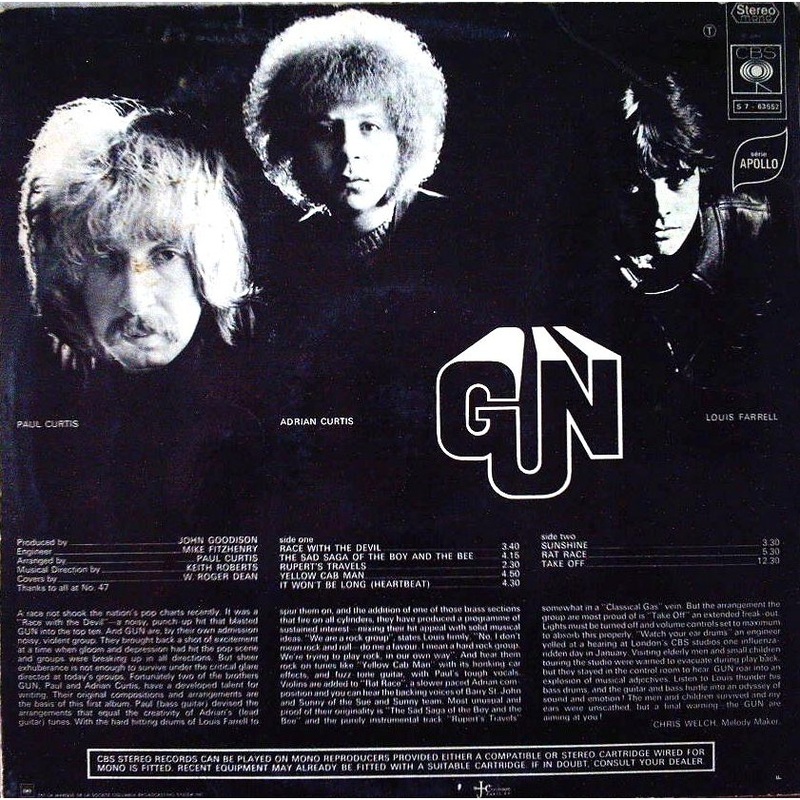
The year was 1968 and Cream, that most awesome of super-groups had disbanded due to the acrimonious tendencies of its rhythm section.  Unfortunately, without the bass and drums of Jack Bruce and Ginger Baker there wasn't much left, even if what remained was Eric Clapton at the peak of his godliness.  A number of bands rushed in to fill the gap, but, it clearly wasn't going to be easy.  Into the mix came a brotherly guitar and bass duo with a sound close enough to Creams to meet the demand, but distinct enough to be more than a mere imitation.  

Three British lads, Adrian and Paul Gurvitz, along with drummer Louis Farrell formed "Gun" and quickly recorded their first album, charting a hit (Race with the devil) in England.  The songs opening appears to intentionally echo Cream's intro to White Room, while other parts of the song call to mind another forgotten gem of the period "The Crazy World of Arthur Brown's" song "Fire."  The basic riff , however, has enough muscle to stand on  its own, making it more than just a pastiche of current (For the time) trendiness.  

Adrian, the standout of the trio had pretty much nailed Clapton's sinewy vibrato and "Woman Tone" which in 1968 was a sufficiently worthy achievement among guitarists to inspire awe.  

Unlike most of their fellow travelers on the newly emerging heavy rock scene, Gun occasionally used horns, giving them a toehold in the equally new progressive rock scene.   

In 1969 the band followed up with a second album that went nowhere and then promptly broke up.  Gun never really achieved noteworthy success in the U.S., although they were a part of the growing underground during the music's infancy. 

Adrian eventually hooked up with the aforementioned Ginger Baker in the equally short lived "Baker Gurvitz Army."  A decade or so later he entered into the most lucrative phase of his career as an award winning songwriter for films like "The Bodyguard."

Melody Maker at one time named Adrian as the ninth greatest guitarists in the world, which seems an oddly specific number when attempting to quantify guitar awesomeness, but, such is the nature of pop culture.

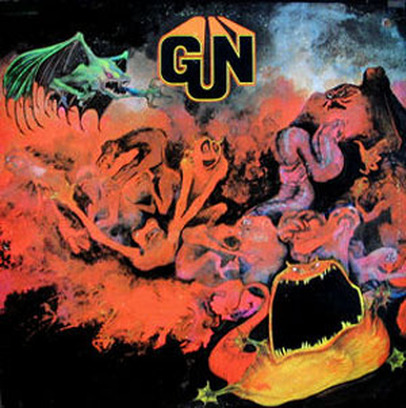
Gun remain a compelling, although largely forgotten chapter in the evolution of hard rock in its embryonic stage.   Their first album is something of a forgotten near-classic for aficionados of the form, with a very cool album cover, to say nothing of the devilish lyrical imagery that only a year later would pay off big-time for another British band.  

Either way, dig their raucous, youthful, heaviness and check them out.  You will be too cool for the sheer obscurity of it all, and you'll hear some pretty imaginative music in the process. 

Mark Magula
Picture
Picture
0 Comments

Jim Hall 

12/11/2013

0 Comments

 
Jim Hall didn't play like everybody else.  In the relatively short history of the Jazz guitar he was a true original.  If that sounds like a cliché, it was, nonetheless, true.  He approached the instrument with an understated sophistication that was unique for its time—and still is.  When every other guitarist in a post Charlie Christian, Charlie Parker world sought to adapt the legato attack and ferocious tempos of Modern jazz to the guitar, Hall went in the other direction.  Like Miles Davis, Lester Young and Paul Desmond (a frequent collaborator) melodic variation and harmonic refinement were the essence of his playing.  

He possessed a sense of adventure that made his solos seem fresh, as though they were being invented at the moment, and in large part they were.  Hall’s subtle radicalism, was, like Bill Eva’s piano, centered on harmonic coloration and invention instead of the usual scalar be-bop-isms that became typical of the music, particularly among guitarists.


In the early stages of his career he developed a reputation as a significant stylist during his tenure with The Jimmy Giuffre trio and Art Farmer's band.  In one of the most demanding gigs for any guitarist, Hall joined Sonny Rollins comeback group following Sonny's much publicized sabbatical from the jazz scene.  He became an integral part of one of Rollins greatest records “The Bridge.” Both men took some heat for having a guitar player with the wrong pigmentation in the band, with most of the blow-back coming from musicians of "Color" who thought Sonny should keep it pure. 
Thankfully, Rollins stuck by his decision, even if it was for only one record.  

It's remarkable how much things can change in fifty years, but still remain the same. 

Hall was a perfect foil for Sonny's extended improvisations and re-harmonization.  His unique chord-voicing and subtlety opened up the sound of the band, leaving plenty of room for Rollins to play, unimpeded by the more orchestral nature of the piano.  Gerry Mulligan used a piano-less trio, at about the same time for similar reasons. Either way, the band is preserved on record and film, a rarity for the period. 

You can watch as well as listen to Hall’s unhurried approach when negotiating the complex changes taken at tempos that would intimidate the hell out of most musicians.  It's hard to imagine that he wasn't awed by it all.  If he was, he appears to deal with it with a Zen-like cool.  He simply takes his time and chooses not to give in to the impulse to play in a way that is more about dexterity than creativity.  In doing so he points the way for succeeding generations of guitarists uninterested in cutting heads as a primary method of musical communication.  

Hall's musical demeanor gave birth to a whole school of guitarists that used his approach as a template.  Pat Metheny and John Abercrombie were just two of his better known disciples.  Remarkably, he stayed in the vanguard of jazz for some sixty years, remaining relevant as a player even as styles changed and gave way to supersaturated displays of virtuosity.  He was, perhaps, the last of the greatest generation of jazz guitarists, which included Wes Montgomery, Tal Farlow, Joe Pass, Barney Kessel, Chuck Wayne and too many others to list without a much, much longer article.  Only Kenny Burrell, I believe, remains active, still gigging and teaching at the university level. 

There’s a wealth of recordings and videotaped material to keep his music alive.  His many acolytes remain as well, preaching his gospel of humor, subtlety and intelligence, traits that are rare among the six string brethren.  They are, however, abundant in his work.  


You could spend a lifetime absorbing his lessons—and I have little doubt that will be the case for generations to come.  In terms of legacy, I'm not sure any musician could ask for more.

Mark Magula

0 Comments

Led Zeppelin live in 1970

12/1/2013

0 Comments

 
Led Zeppelin live 1970, with excellent sound quality. 
This is the band when they were young, hungry and unpredictable, before the music was carved in stone.  Robert Plant sings with the bluesy screech and howl of his mentors, effectively adapted for the era of Marshall stacks and huge drum kits.  Jimi Page plays like Otis Rush and Scotty Moore had a baby.  John Bonham takes the thunder of Ginger Baker and reduces it to an essence.  And John Paul Jones holds it all together.  This was before anyone was sure what to call it; acid rock, hard rock, heavy rock.  The one constant was the word rock.  Not rock and roll, but, rock, as in; a big, mountainous range of amplification, with riffs so awesome they could melt steel.  This wasn't your parents blues, this was long-haired androgyny fused with the Hell's Angels by the way of Howlin' Wolf.  Oh, those were the days!

Mark Magula
0 Comments

Set Rogan and James Franco: Bound

12/1/2013

0 Comments

 
This is the most vile, repulsive piece of crap I've ever seen.  Not because of Seth Rogan and James Franco. They're actually funny.  It's Kanye West's horrific rap that's the problem!  Could a lyric, a poem or a rap be any dumber?  I don't think so!  This is a milestone in bad writing. I can't wait till this generation ages a bit and comes to the conclusion that these cretins were a low water mark in human history
0 Comments

    Archives

    March 2014
    January 2014
    December 2013
    June 2013
    October 2012
    September 2012
    August 2012
    May 2012
    April 2012
    March 2012
    February 2012
    January 2012
    December 2011
    November 2011
    September 2011
    August 2011
    July 2011
    June 2011

    RSS Feed